
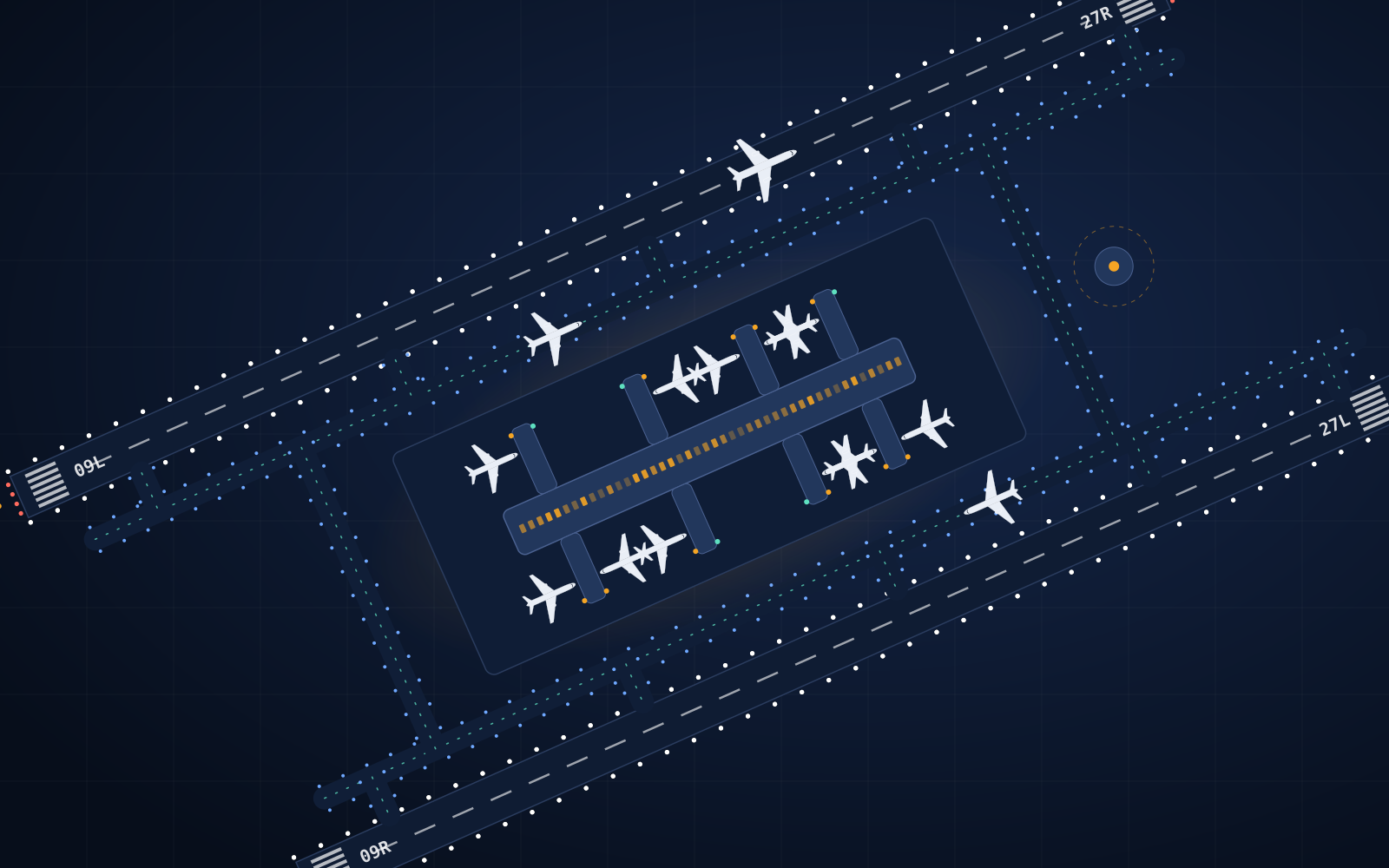
Flight record
The airport's own system of record for every arrival and departure, kept current by airlines, handlers and the tower.
brings the flight schedule, the movement of passengers and the plan for stands, gates and staff onto a single data layer. Follow one operating day below and see what every desk reads from it, hour by hour.
Sponsored feature. This page is paid promotional content about , published by AeroRecord. All product claims are the company's own statements. It is not an independent news article.
Pick a time. Each stop shows what the shared record is doing at that point in the day and who is reading it.
Before the first departures push back, every flight is already a single entry holding its scheduled time, latest estimate, stand, gate and baggage belt. Airlines, handlers and the tower feed it, and every screen in the building reads from it.
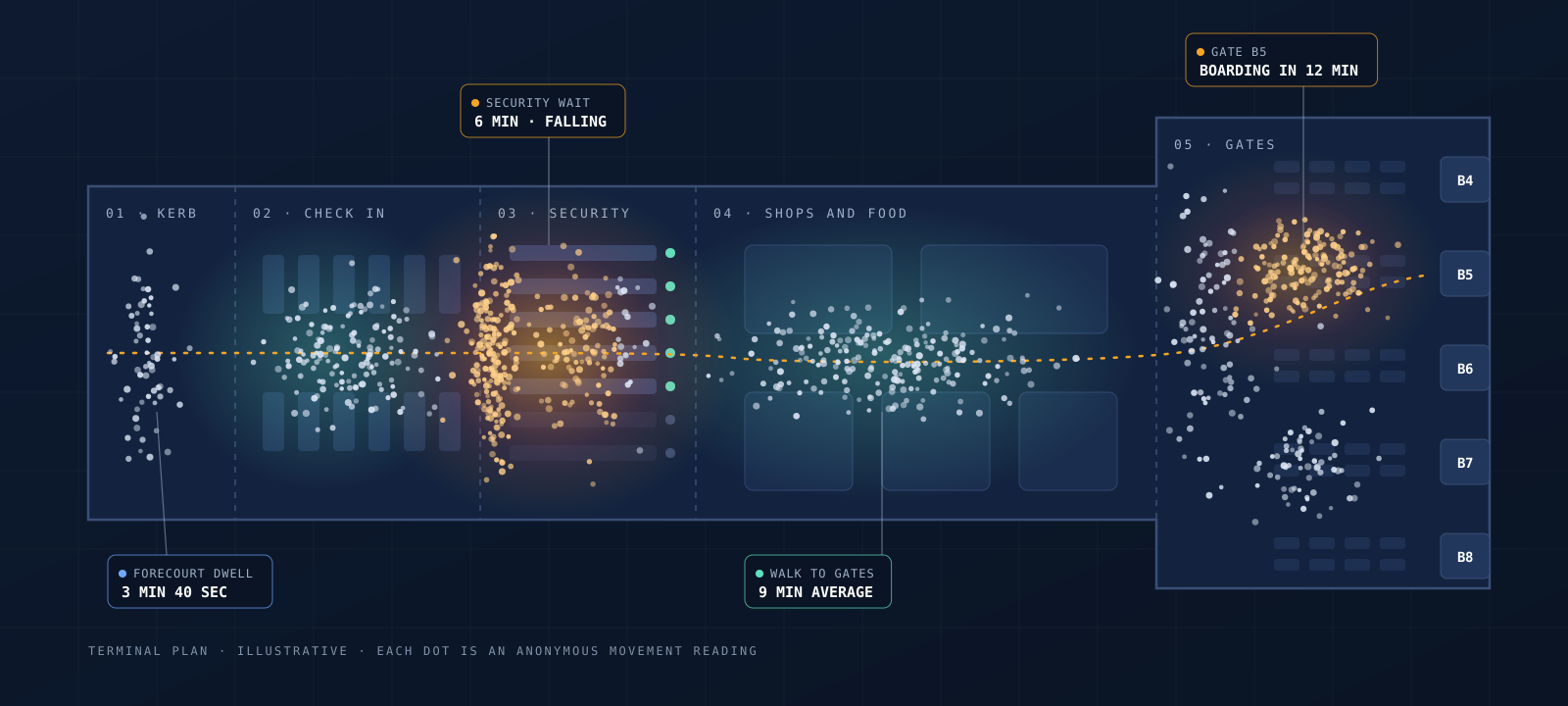
LiDAR, 3D cameras and Wi-Fi readings show where people really are: how long the queue is, how far they have to walk, how long they linger. The platform projects each reading forward, so lanes can open ahead of the surge instead of behind it.
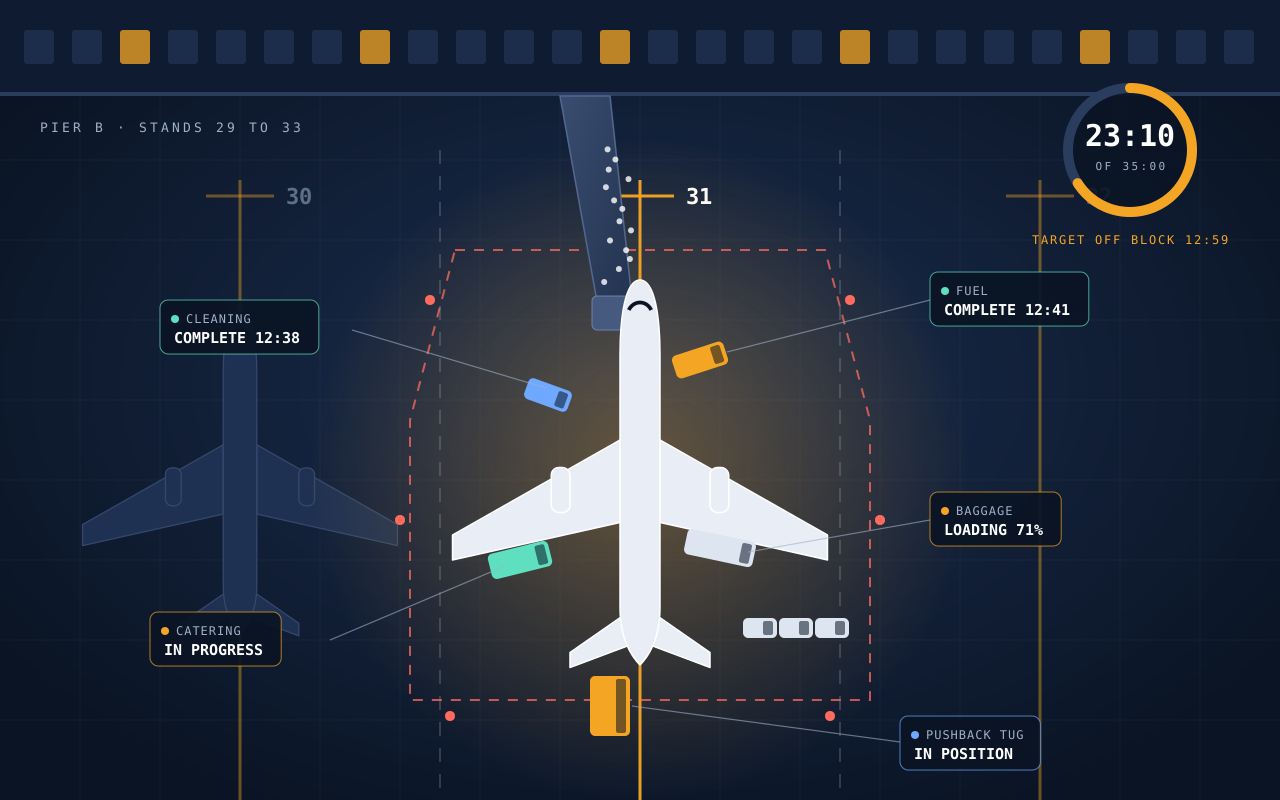
Airline, ground handler and airport share the same target times under A-CDM. Cleaning, catering, fuel and boarding are logged against one countdown, so the off-block time is a single number for everybody watching it.
Forecourt, check-in, security, shops and boarding stop being separate reports. They become one continuous flow, with the pressure in each area visible to the people who can do something about it.
When the last aircraft is parked, the day is already costed. Landing, parking and passenger charges are worked out from what actually happened on the ground, which is how the gap between activity and invoice gets closed.
Each module does a different job for a different team. What they share is the record they read from and write to.
The airport's own system of record for every arrival and departure, kept current by airlines, handlers and the tower.
LiDAR, 3D cameras and Wi-Fi readings that measure queues, walking times and dwell as they happen.
Forward estimates for when a queue clears, boarding begins or a stand frees up, sharper the nearer the event.
Shared A-CDM target times, so airline, handler and airport all work to the same off-block number.
The whole journey from forecourt to boarding gate in a single view, with pressure points flagged early.
Landing, parking and passenger charges billed straight from the movement record, not rebuilt afterwards.
An aircraft arrives on stand and a countdown begins that almost nobody in the terminal ever notices. Passengers off, cabin cleaned, galleys restocked, tanks filled, the next passengers on. All of it has to fit inside one short window, and on a crowded summer morning there is very little slack in it.
For years the difficulty was not the countdown. It was how many people were running their own. The airline's control centre had one, the handler had another, the stand planners a third and the fuel supplier a fourth. They were usually compared only once the aircraft had already left late.
A turnaround slips in the space between what was planned and what is happening. Put both on one record and that space gets very small.
The idea behind the shared recordis built around that shared record. One entry per flight, visible to airline, handler and airport alike, with a target off-block time that moves as the work on the stand moves. The same layer carries the passenger picture too, so the people watching the queues and the people watching the stand are reading one account of the day.
The record does a second job after the aircraft has gone. Charges for the landing, the hours parked and each passenger are taken from what really took place, so the invoice and the movement log tell the same story. A briefing is the place to ask how that would sit alongside the systems your airport already runs.
The value of a shared record shows up when different departments stop arguing about whose numbers are right.
The same airport day, described two ways. This is an illustration of the idea, not a set of measured results.
Nothing on this page is an offer, a price or a commitment.
Which of your current systems would feed the record, and which would read from it.
How the platform would be hosted for your airport and what a realistic rollout looks like.
Ask for up to date customer numbers and reference airports first hand, so they come straight from the source.
Tell AeroRecord which part of the platform matters to you and how to reach you. It takes about a minute.
Not wholesale. It sits above the systems an airport already runs and feeds displays, dashboards and billing from one flight record. The airline systems around it stay where they are.
AeroRecord receives your details and contacts you to arrange a briefing on the topic you chose. Sending the form is an enquiry. It is not a login, a purchase or a contract.
Airlines and handlers supply the schedule. Sensors such as LiDAR, 3D cameras and Wi-Fi measure movement. The platform merges both into estimates and predictions, then publishes them back to the systems that need them.
In the cloud, on-premise or as a managed service, depending on the airport's own constraints. The record and the modules are the same in each case. Only who runs the infrastructure changes.
It turns the movement record into invoices. Charges for each landing, each parked hour and each passenger are counted from what happened on the ground.
No. This is a paid promotional feature published by AeroRecord. The operator is AeroRecord Systems Pty Ltd, Suite 4.02, Level 4, 15 Avionics Way, Tullamarine VIC 3043, Australia. Phone +61 3 9335 8420. Email info@tripplemon.com.
Please read the disclosure, disclaimer and policies below.
This page is a promotional feature about 's airport operations platform, published by AeroRecord for readers in the United Kingdom. Product claims are the company's own statements. The page is not news and not editorial.
Product descriptions are the company's own and change over time. On-page displays, flight numbers and readings are illustrations, not live data or measured results. Nothing here is procurement, contractual, legal or operational guidance, and no airport or airline endorses this page.
The briefing form asks for your name, email, phone number and, if you wish, your organisation, so AeroRecord can contact you. The privacy policy explains how that information is handled.
The terms of use apply to reading this page and to sending a briefing request. Sending the form does not buy software and does not create a contract.